
- hindi news
- Career
- DRDO Ballistic Missile Defense System Successful Testing | India Defense News
38 minutes ago
- copy link
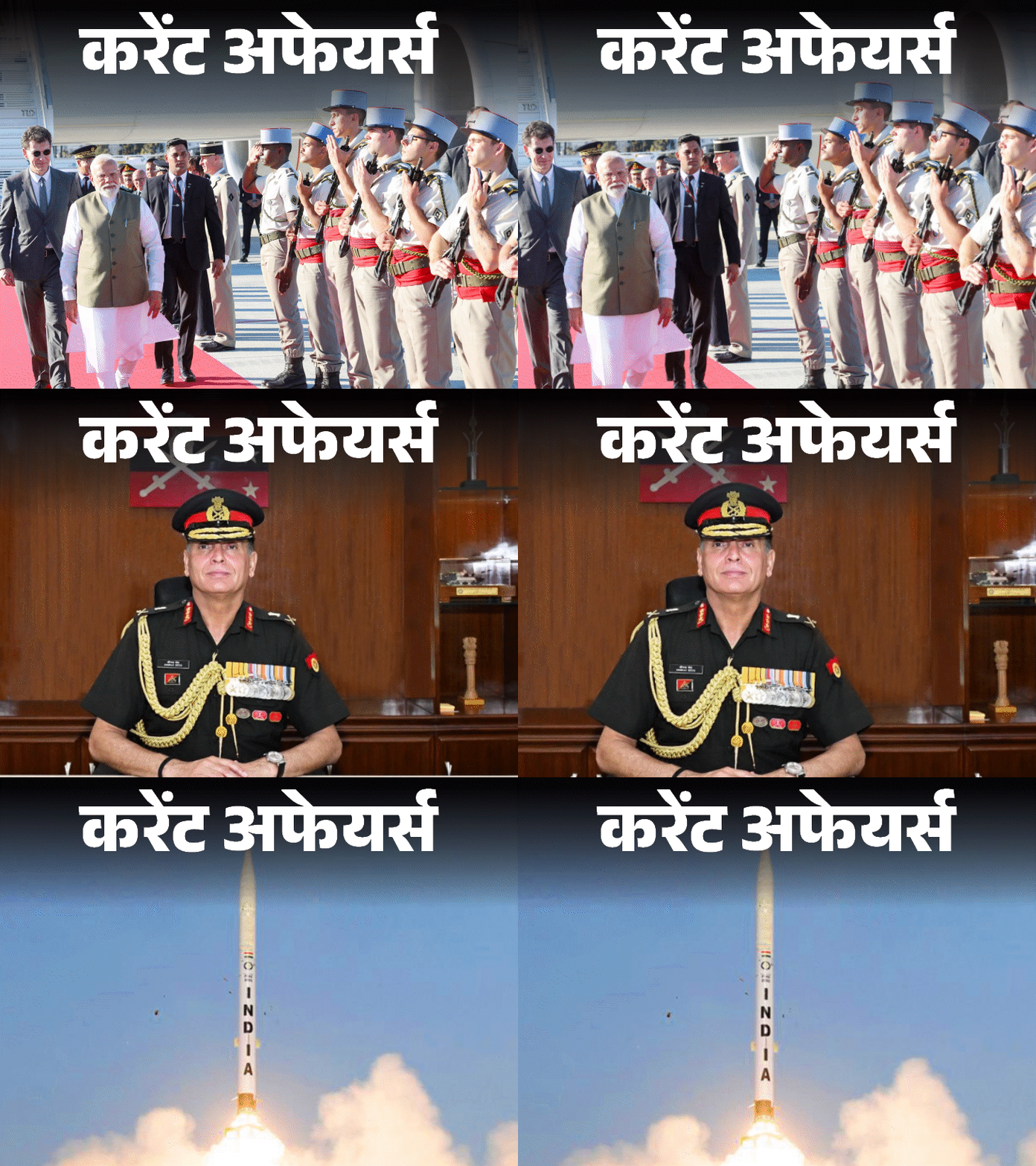
Today’s major current affairs, which are important for students preparing for government jobs-
International
1. PM Modi reached France and Slovakia
- On June 14, PM Narendra Modi reached Nice, France in the first leg of his visit.
- On the first day, PM Modi inaugurated the ‘Bharat Innovates’ program along with French President Emmanuel Macron.
- Bharat Innovates is a global initiative of the Ministry of Education of India, which was announced by Prime Minister Modi during the inauguration of the India-France Year of Innovation in February 2026.
- The PM also held bilateral talks with French President Emmanuel Macron during the visit.
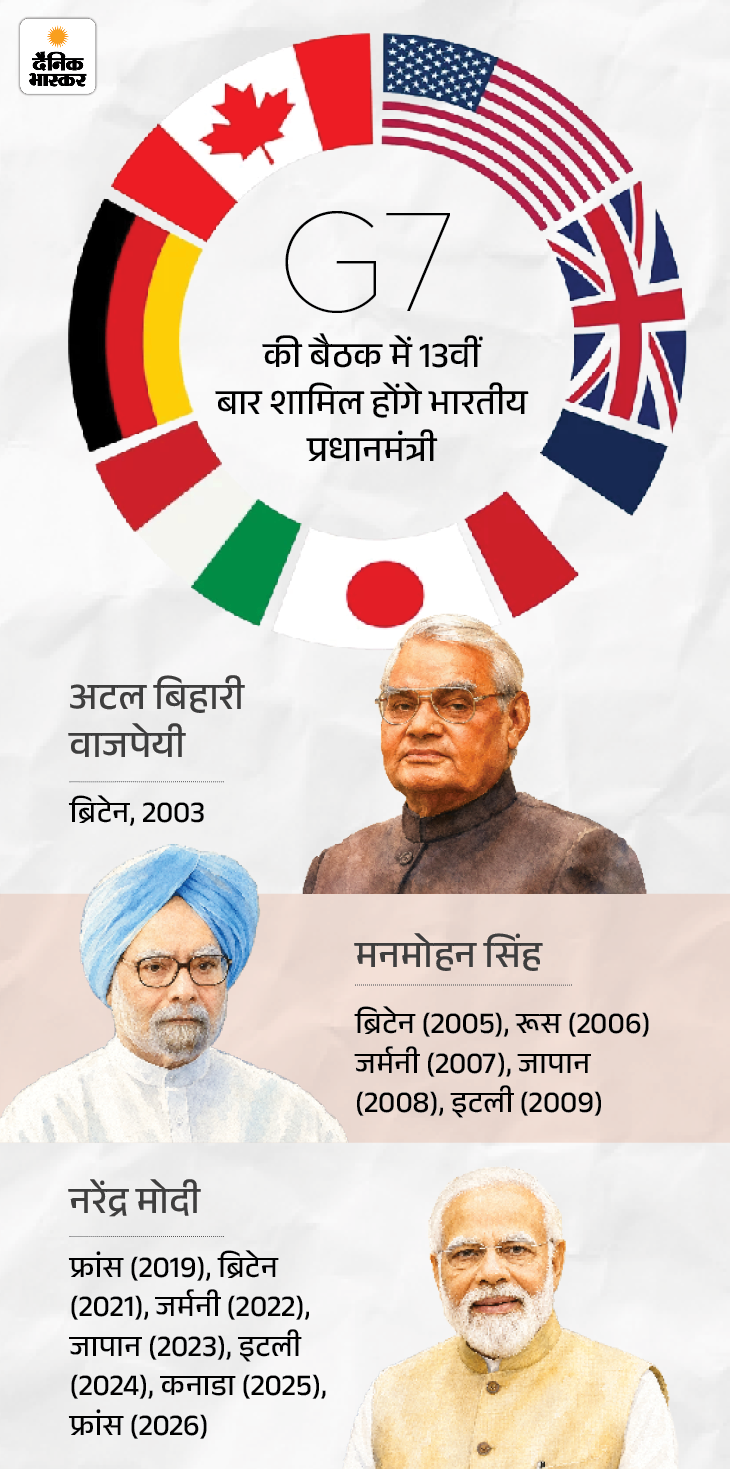
- On June 17, PM Modi will attend the G7 summit and in this summit he will also meet US President Donald Trump.
- PM Modi and Trump had earlier met in Washington in February 2025.
G7 (Group of Seven)
- G7 i.e. ‘Group of Seven’, is a group of 7 countries of the world, which are called ‘modern economy’ countries of the world.
- G7 includes America, France, Britain, Japan, Italy, Canada and Germany.
- It debuted in 1975 as the G6. It became G7 after Canada joined in 1976.
- In 1998, Russia was included and renamed G8, but in 2014 it was expelled from the group after Russia’s annexation of Ukraine’s Crimea region. After this it again started being called G7.
- India is not a member of the G7, but is often invited as a guest country due to its leading economy and important global role.
- PM Modi is on a visit to France and Slovakia from 13 to 17 June.
- This is the first visit by an Indian PM to Slovakia after it became an independent country in 1993.
NATIONAL
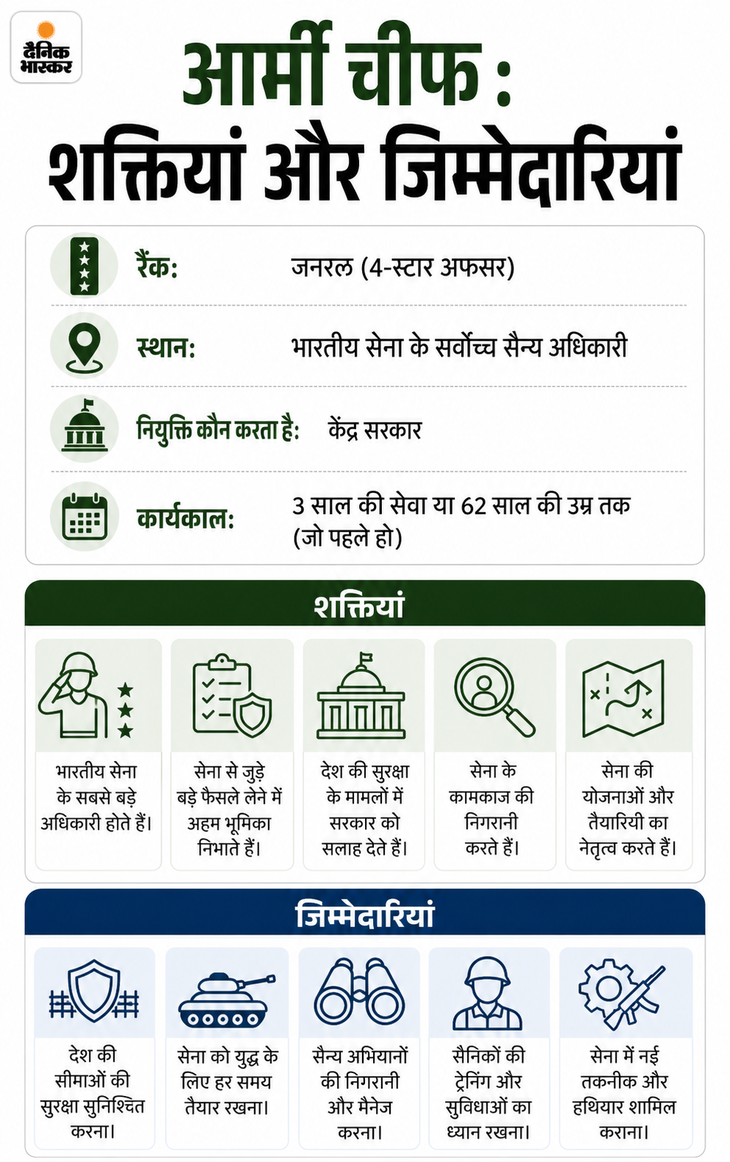
2. Lieutenant General Dheeraj Seth will be the new Army Chief Staff
- On June 13, the government appointed Lieutenant General Dheeraj Seth as the next Chief of Army Staff.
- Lieutenant General Dheeraj will take charge from June 30.
- The Lieutenant General will replace Army Chief General Upendra Dwivedi, who will retire from the post on the same day.
- Lieutenant General Dheeraj Seth has been a student of National Defense Academy (NDA) Khadakwasla.
- In December 1986, he was commissioned in the ‘Armoured Corps’.
- In 2021, Lieutenant General Dheeraj served as the Operations Officer in the United Nations Mission in Angola (UNAVEM III).
- Lieutenant General Dheeraj took command of South Western Delhi in 2022 and took charge of XXI Corps (Sudarshan Chakra Corps).
- In 2024, Lieutenant General Dheeraj was the Army Commander in the South Western Command.
- Along with this, Lieutenant General Dheeraj also led the Rudra Shakti operation in 2024.
- Lieutenant General Dheeraj is the Vice Chief of the Army Staff from April 2026.
- Lieutenant General Dheeraj has also led the Armored Regiment in the desert area, the Western Area and the Anti-Terrorist Squad in Jammu and Kashmir.
3. Indian Army officers will now be able to wear bandi jackets
- On June 14, the Indian Army released its new dress regulation booklet (Army Uniforms-2026).
- According to the new dress regulation, for the first time, bandi jacket i.e. closed neck coat has also been included in formal dress.
- According to the new rule, now army officers will be able to wear bandi jackets while on duty.
- The jacket will be worn over a full-sleeve shirt and will be simple and sober and not in any flashy colour.
- It will be mandatory to wear trousers and closed shoes to match with the captive jacket.
- Whether the jacket has a neck hook or not, both types of designs will be valid.
- Along with this, the ceremonial pouch belt has been removed from dress number 5 and number 6.
- At the same time, carrying a sword with the reviewing officers during the parade has been made optional.
- Under the rules, women officers can wear plain colored sarees or kurta-salwar with dupatta and ankle-length straight pants.
- This rule clearly prohibits wearing sleeveless kurtas and casual lowers like palazzo or pants.
- Information about these amendments has been given in the recently released 174-page manual ‘Army Uniforms-2026’.
- This change has been made to reduce the colonial-era traditions present in the army uniform.
- The manual states that the purpose of these changes is to gradually eliminate colonial vestiges while maintaining the dignity, functionality and traditions of the army.
- The Adjutant General’s Branch issues the Dress Regulation Booklet.
- All guidelines, designs and grooming standards related to Army uniforms are regularly updated and published under this wing.
4. DRDO conducted 3 successful flight missile tests
- DRDO conducted 3 consecutive flight tests on 10 and 11 June, demonstrating the multi-layered Ballistic Missile Defense (BMD) system.
- Defense Minister Rajnath Singh shared this information on social media X account on June 13.
- In this testing, India’s ability to intercept long-range ballistic missiles and Intercontinental Ballistic Missile (ICBM) class threats was also tested.
- In this testing, DRDO successfully tested AD-1 and AD-2 interceptor missiles.
- These missiles are capable of identifying, tracking and destroying enemy ballistic missiles with a range of 2,000 to 5,000 kilometers in the air.
- According to the Defense Ministry, these tests have brought India into the category of countries having BMD capability to deter ICBM-level threats.
- Ballistic Missile Defense System is an advanced defense network, which includes powerful radar, command center and interceptor missiles.
- The purpose of BMD is to detect, track and destroy enemy ballistic missiles before they reach the target.
- These systems can intercept missiles both within the atmosphere (endo-atmospheric) and in the space region (exo-atmospheric).
- This testing will strengthen India’s multi-layered missile shield.
- Like the US, Russia, China and some other countries, India has now joined the group of countries with advanced BMD capability.
- India has joined the countries to eliminate the threat of Intercontinental Ballistic Missile (ICBM).
- The Ballistic Missile Defense System also includes the capability to intercept and neutralize ballistic missiles, including threats up to the Intercontinental Ballistic Missile (ICBM) class.
- This indigenous technology destroys enemy missiles in the air before they reach the target.
- India has now joined the elite group of countries which have operational-level ballistic missile defense capability.
- Before India, America, Russia, Israel and China had this technology. India has become the 5th country to have ballistic missile defense system.
- In simple language, Intercontinental Ballistic Missile can be called a very long range missile.
- This is a missile that can reach from one continent to another.
- Usually it can hit a distance of more than 5,500 kilometers. Apart from this, it is also capable of carrying nuclear weapons.
- This missile goes up towards space like a rocket, then returns towards the earth from a very high altitude and attacks the target at very high speed.
- For this reason it is counted among the most powerful strategic weapons in the world.
- Along with this, Naval Anti-Ship Missile Medium Range (NASM-MR) was also successfully tested.
- This is being considered a major achievement in the direction of strengthening India’s maritime strike and defense skills.
AD-1 and AD-2
- The AD-1 is a long-range two-step interceptor, which can intercept medium and long-range ballistic missiles.
- AD-2 is an advanced interceptor of Phase-II BMD system, which has been developed to eliminate high speed and ICBM category threats.
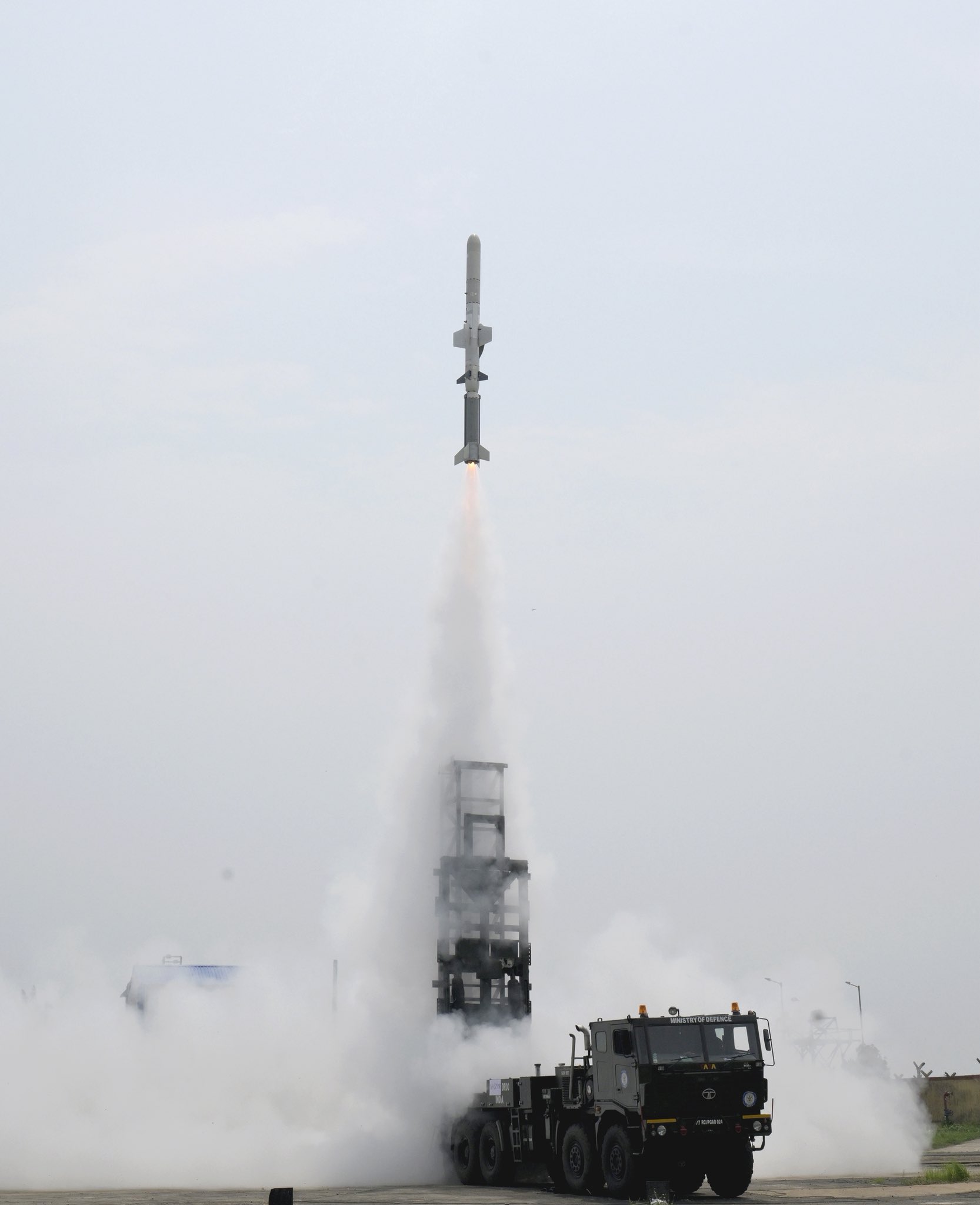
Before India, America, Russia, Israel and China had this technology.
MISCELLENEOUS
5. Central government approved 100% pure ethanol
- On June 13, the Central Government has approved the use of 100% pure ethanol as fuel in the country.
- Union Road Transport and Highways Minister Nitin Gadkari gave this information in a press conference in Nagpur.
- The main objective of increasing the use of pure ethanol is to reduce the country’s dependence on crude oil (fossil fuel) imports.
- Use of ethanol will also reduce pollution caused by vehicles and is an economical and sustainable option.
- India currently fulfills a large part of its requirement by importing crude oil from abroad.
- According to Union Minister Nitin Gadkari, the country’s automobile sector has approved this change.
- Many big companies are fully prepared to launch vehicles running on 100% ethanol in the market.
- According to the Union Minister, some companies including Toyota, Suzuki, MG and Hyundai will launch ethanol-powered vehicles within the next 6 weeks.
ethanol
- Ethanol is a type of alcohol, which is made from the fermentation of starch and sugar.
- It is mixed with petrol and used as eco-friendly fuel in vehicles.
today’s history
- Calcutta Stock Exchange started in 1908.
- In 1947, the All India Congress Committee, at its session in New Delhi, approved the proposal for the partition of India. It is also called Mountbatten Plan.
- In 2006, India and China decided to open the Old Silk Route.
——————–
today’s history
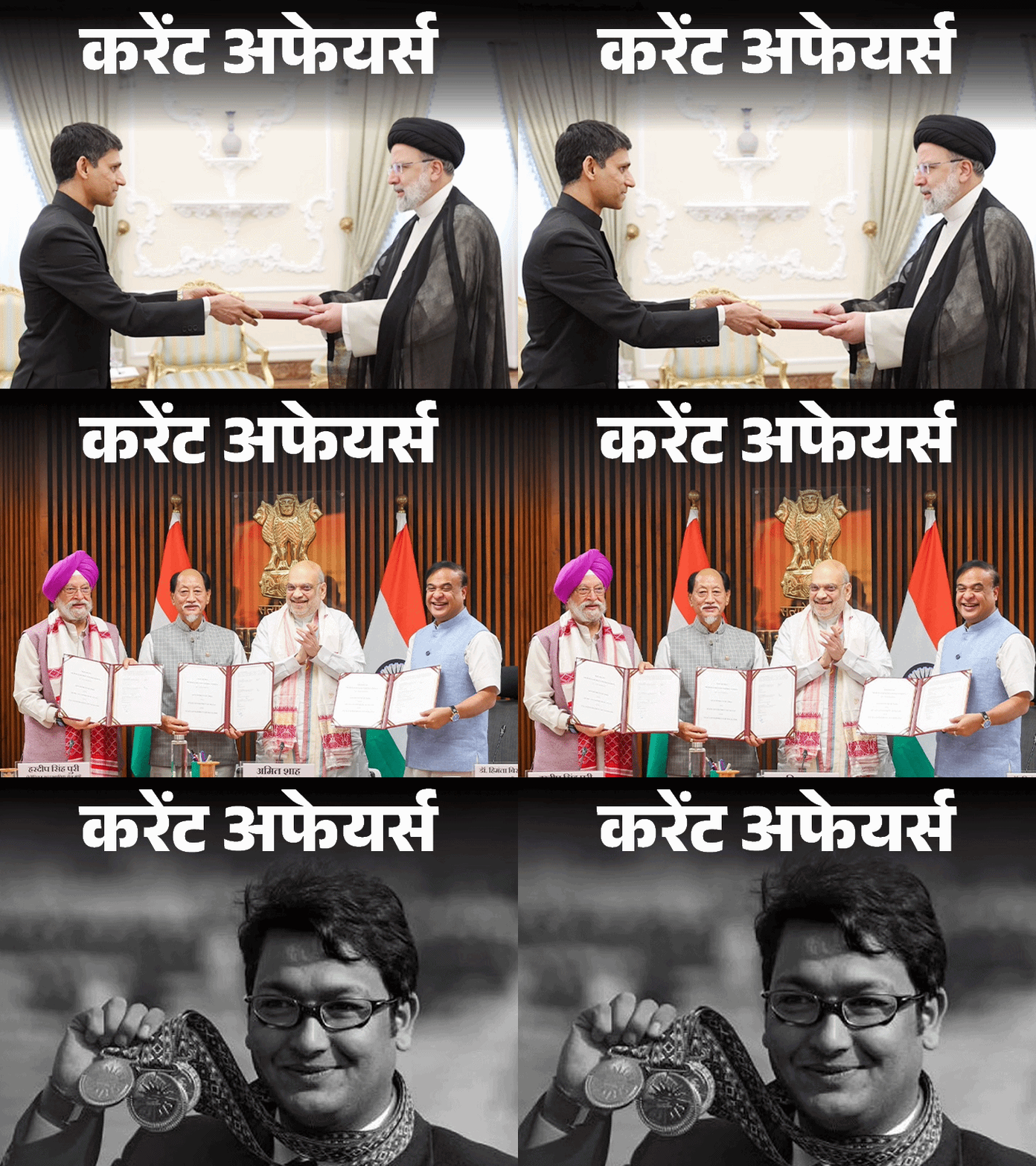
Assam-Nagaland states will now jointly produce crude oil: Senior diplomat Rudra will be the new Ambassador of India to Türkiye, Current Affairs of June 13
Today’s major current affairs, which are important for students preparing for government jobs-Read the full news..