
- hindi news
- Career
- ISRO Opens Astronaut Cadre To Public For Gaganyaan Mission STEM Experts Join
20 minutes ago
- copy link

Indian Space Research Organization (ISRO) has decided to open its astronaut cadre to common citizens for the first time. ISRO’s Astronaut Selection Committee has recommended this. However, its criteria have not been released yet.
The committee’s recommendation states that 6 Air Force pilots along with 4 civilian specialists should be included in the second batch of astronauts of the Gaganyaan mission. These civilians will be from Science, Technology, Engineering and Math (STEM) background.
First batch of only pilots, entry of common people in the second
- first batch: For launch of Gaganyaan mission (IAF pilots only).
- second batch: For future missions and research (pilot + civilian/scientist).
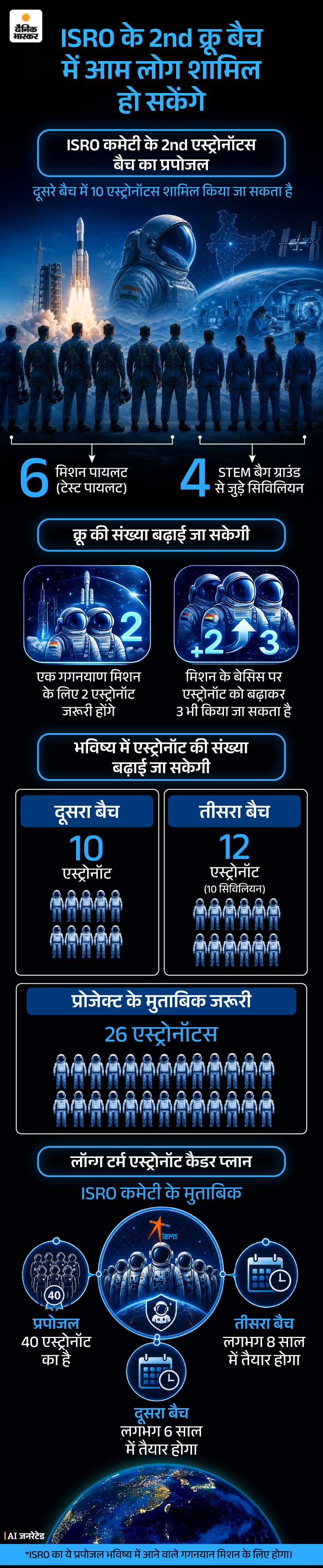
Training will take 4 and a half years, second batch will be ready by 2030
From selection of an astronaut to his training and preparation for the mission, it takes about 4 and a half years (54 months). The committee has set a target that the second batch should be completed in the next 72 months and the third batch in 96 months.
Civilian flights will start from the fourth Gaganyaan mission
Even though civilians are being included in the second batch, they will not go to space immediately. According to the committee’s plan, civilian astronauts will be made part of the crew from the fourth manned mission. It has been a tradition across the world that before the technology matures, only pilots with military background are sent, only after that it is the turn of civilians.
4 astronauts included in the first batch of Gaganyaan mission
Mission Gaganyaan is ISRO’s first crewed space flight program, which will launch by 2027. This will be a mission of 3 days. In this, 3 astronauts will travel 400 km into space. They are designed to return them safely to Earth.
The first batch includes four astronauts. ISRO’s first batch included test pilots from the Indian Air Force (IAF). Four astronauts were selected in this. The purpose of selecting these astronauts is to safely deliver the first crew mission.
Fighter plane’s Air Commander Prashant B Nair, GP Captain Shubhanshu Shukla, GP Captain Ajit Krishnan, GP Captain Angad Pratap were included in the first batch. The second batch may also include fighter jet combat helicopter pilots of the Indian Army.
Out of 12 astronauts in the third batch, 10 will be civilians.
After the seventh mission, ISRO will increase the capacity of its mission, so that 3 astronauts will be able to go to space simultaneously. For this, 12 astronauts will be required in the third batch. The ratio will change completely in this batch, in which only 2 mission pilots and 10 civilian specialists will be included.
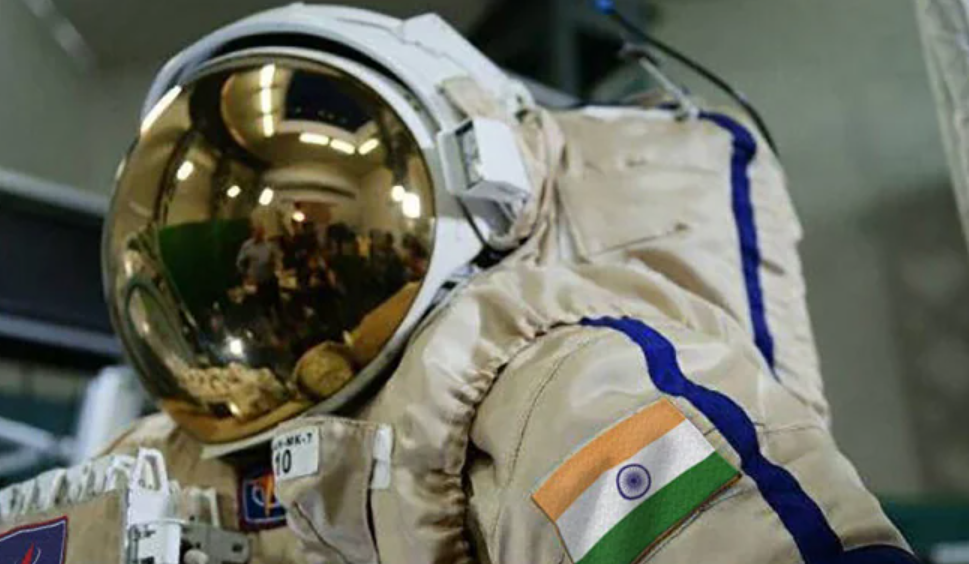
This expansion is related to the big plans of the Indian Space Station.
Preparation to create two missions annually and a pool of 40 astronauts
ISRO is now working towards creating a permanent astronaut cadre. Under this, there is a plan to send two human missions in a year. The committee has estimated that considering the long-term needs and international opportunities, India should create a strong pool of a total of 40 astronauts.
Delay in infrastructure and life support system is a big challenge
Amidst the preparations for the mission, ISRO is also facing the challenge of infrastructure. At present there is only one temporary training center for astronauts in the country, the process of creating a permanent facility is yet to begin.
Additionally, the development of critical technologies such as ‘Environmental Control and Life Support System’ (ECLSS) for the first unmanned mission is also lagging behind, without which human life in space is not possible.
——————–
Read this news also..
Raghu Rai, who took photographs of Bangladesh war, passes away: PM Modi will go to Sikkim on a two-day visit, current affairs of April 27
Know today’s major current affairs, which are important for students preparing for government jobs…Read full news..