
- hindi news
- Career
- Bihar Schools: No Electricity, Water & Just One Teacher; Teachers Shortage Worse
2 hours ago
- copy link
The recent report released by NITI Aayog shows that Bihar ranks first in shortage of teachers in the state. According to the report, 2.08 lakh elementary, 36,035 secondary and 33,035 senior secondary teacher posts are lying vacant in Bihar. That means approximately 2,77,070 posts are vacant.
This report was released at a time when protests are taking place in Bihar demanding teacher recruitment. On May 8, there was lathicharge on the candidates protesting against the demand of BPSC TRE-4 notification, about 500 protesters were detained and 4 were arrested.

Police lathi charged the candidates demanding notification of BPSC TRE-4 recruitment in Patna.
Apart from Bihar, the posts of Elementary, Secondary and Senior Secondary teachers are also vacant in states like Jharkhand and Madhya Pradesh.
11 important insights from NITI Aayog report:
NITI Aayog released the report titled ‘School Education System in India’ on 7 May. This report gives a complete picture of India’s school education system in the last 10 years.
1. 4 out of every 10 students are dropping out of higher secondary education.
The current school education system is like an upright pyramid. There are many primary schools in it, but as the class increases, the number of schools decreases.
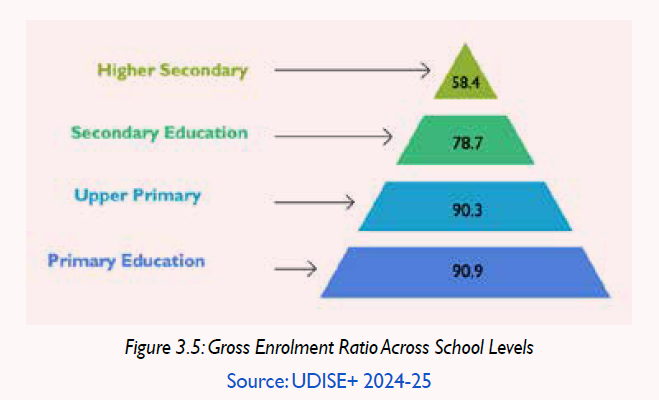
The Gross Enrollment Ratio (GER) at the primary level in the country is 90.9%, that is, most of the children are reaching school in the initial classes, but by the time they reach the secondary level, this figure reduces to 78.7%. At the higher secondary level, it further falls to only 58.4%.
This means that about 4 out of every 10 children drop out of school before reaching higher secondary.
According to the report, there are only 5.4% schools where children can study continuously from class 1st to 12th. Most of the remaining students have to change schools from time to time. This is also a major reason for children leaving studies.
This dropout rate at primary level is 0.3%, at upper primary this rate is 3.5% and at secondary level it is 11.5%.
According to the report, the highest dropout rate has been recorded in West Bengal at 20%. After this, 18.3-18.3% children in Arunachal Pradesh and Karnataka, while 17.5% children in Assam are leaving studies at the secondary level.
2. Electricity in 1.19 lakh schools, no drinking water in 14,505 schools
According to the report, the data of UDISE+ 2024-25 shows that even today 1.19 lakh schools in the country do not have proper electricity facility. The condition of water and sanitation facilities is also not the same everywhere.
However, from 96.5% schools in 2014 that had drinking water facilities, this has increased to 99% by 2025. Despite this, there are still 14,505 schools where there is no proper arrangement for drinking water. At the same time, about 59,829 schools do not even have hand washing facilities, which affects the health and hygiene of children.
The report shows that about 50% of government secondary schools are running without science labs. Internet penetration in schools has increased eightfold in the last few years to 63.5%. Despite this, one-third of schools still do not have internet connectivity.
Demand for private schools is continuously increasing
According to the report, the number of private unaided schools may be less, but the share of children studying in them has increased rapidly. While only 31.7% students were in private schools in 2014-15, this figure increased to 38.8% in 2024-25.
On the contrary, the share of children studying in government schools has declined in the last ten years. The share of government schools in total enrollment was 54.3% in 2014-15, which decreased to 49.25% in 2024-25.
About 10% of children study in government-aided schools, and their share has also declined slightly during this period. According to the report, this is an indication that the demand for private schools among families is continuously increasing.
Quality of education declined in government schools
According to the report, enrollment of children in primary and upper primary schools has increased, but the ability to read, write and understand has declined.
In 2014, 74.7% of 8th graders could read second grade textbooks, but by 2024 this figure dropped to 71.1%. This means that children are reaching school, but their grip on basic education is weakening.
The report says that only 45.8% students of class 8 are able to solve easy division questions.
Citing PARAKH 2024, the report says that children understand the patterns by rote learning, but they have difficulty in using that knowledge in everyday life.
Financial burden of secondary education on families is increasing
According to the report, primary education in government schools is mostly free, but at the secondary level, one has to spend a lot of money from the pocket on things like books, uniform, commuting expenses, exam fees and private tuition.
According to the estimated data in the report, the expenditure on a child’s education in government secondary schools increases by three to five times as compared to the primary level.
Due to financial constraints, many children left school and started working to take up household responsibilities. According to PLFS 2020-21 quoted in the report, 31% of adolescents aged 14 to 17 years were engaged in some work outside school, while 25% were engaged in household chores. Many girls have to leave school at an early age to take on home and caregiving responsibilities.
SC/ST/OBCs are lagging behind their peers in studies
There is a huge disparity in enrollment as well as educational outcomes for socially and economically disadvantaged groups (SEDGs) such as SC/ST/OBCs.
According to the data of PARAKH 2024, students of SEDGs lag behind their peers in almost every major subject.
At the middle level, only 33% SC and 33% ST students could show proficiency in Maths, while this figure was 39% among OBC students. In comparison, 48% students of general category were proficient in Maths.
The same difference was visible in language also. The performance of SC students was 48%, ST was 49% and OBC was 59%, while the score of general category students was recorded at 60%.
The report says that these figures clearly show the lack of equality in basic education and the deep gap that exists in the level of learning.
No infrastructure in schools for physical inclusion of CwSN
Children with Special Needs (CwSN) face challenges at many levels in ordinary schools. The biggest challenge is that of infrastructure, where only 33.4% of schools in the country have disabled friendly toilets.
Schools for disabled students have 91.77% ramps in 2024-25 compared to 59.77% in 2014-15.
However, even basic infra like, barrier free classrooms, tactile paths and height adjusted furniture are still missing.
7993 such schools where not even a single child studies
According to the latest data of UDISE+ 2024-25 in the report, there are 1,04,125 schools in the entire country, which are dependent on only one teacher. This is more than 7% of the total schools in the country. There are 33,76,769 children enrolled in these schools.
According to the report, Andhra Pradesh has the maximum number of 12,912 single teacher schools. There are 9,172 such schools in Jharkhand at second place and 9,508 such schools in Uttar Pradesh at third place.
There are 7993 schools across the country, where there are teachers but not a single child. Among these, West Bengal (3,812) and Telangana (2,245) have the highest number of such schools.
14% of children’s study time is being wasted due to non-teaching duties.
Under the Right to Education (RTE) Act, at least 800 hours of study and 200 working days have been fixed in a year for primary classes. Whereas in upper primary classes, 1,000 hours of study and 220 working days are compulsory.
But according to the report, due to non-teaching duties of teachers, about 14% of the scheduled study days are not utilized for studies. Because they are employed in many other works like survey, election duty, maintaining records and monitoring of mid-day meals.
Schools are not fully prepared for AI integration in the curriculum
In October 2025, the Education Ministry had announced that Artificial Intelligence (AI) and Computational Thinking will be taught as a basic skill from class 3 onwards. This step has been taken under the New Education Policy (NEP 2020) and NCF-SE 2023.
But the teachers and curriculum themselves have not been prepared according to this technological change. According to the report, capacity-building programs are still small, generic and disconnected from the real needs of classrooms.
The effect of this is that children are leaving school, but they do not have the understanding of AI and data, which will be necessary in both jobs and society in the future.
Story – Sonali Rai
———————–
Read this news also…
NEET UG 2026 exam cancelled: Decision due to fear of paper leak, CBI will investigate; About 23 lakh students took the exam
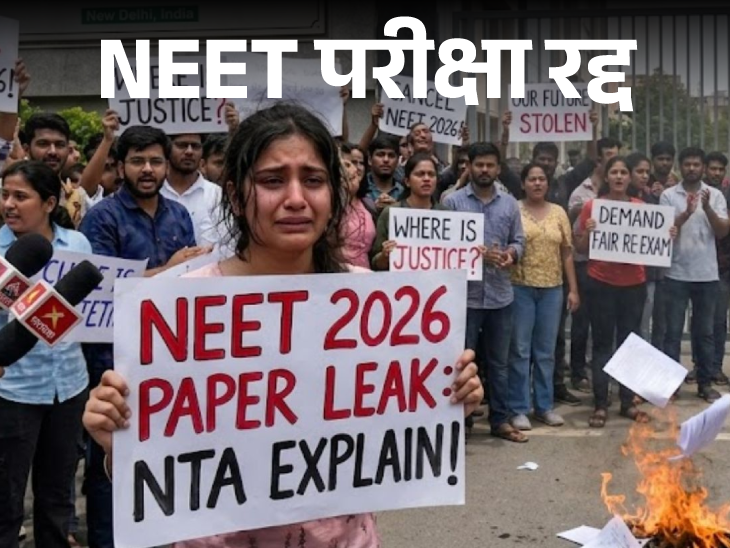
National Testing Agency i.e. NTA has canceled the NEET 2026 examination held on May 3. This decision has been taken due to the fear of paper leak. New exam dates will be released soon. NTA has said that the examination has been canceled after the approval of the Central Government. The case will be investigated by the Central Bureau of Investigation (CBI). Read the full news…