
- hindi news
- Career
- CITU Demands Noida Protest Workers Release | ILO Probe Police Action
5 days ago
- copy link
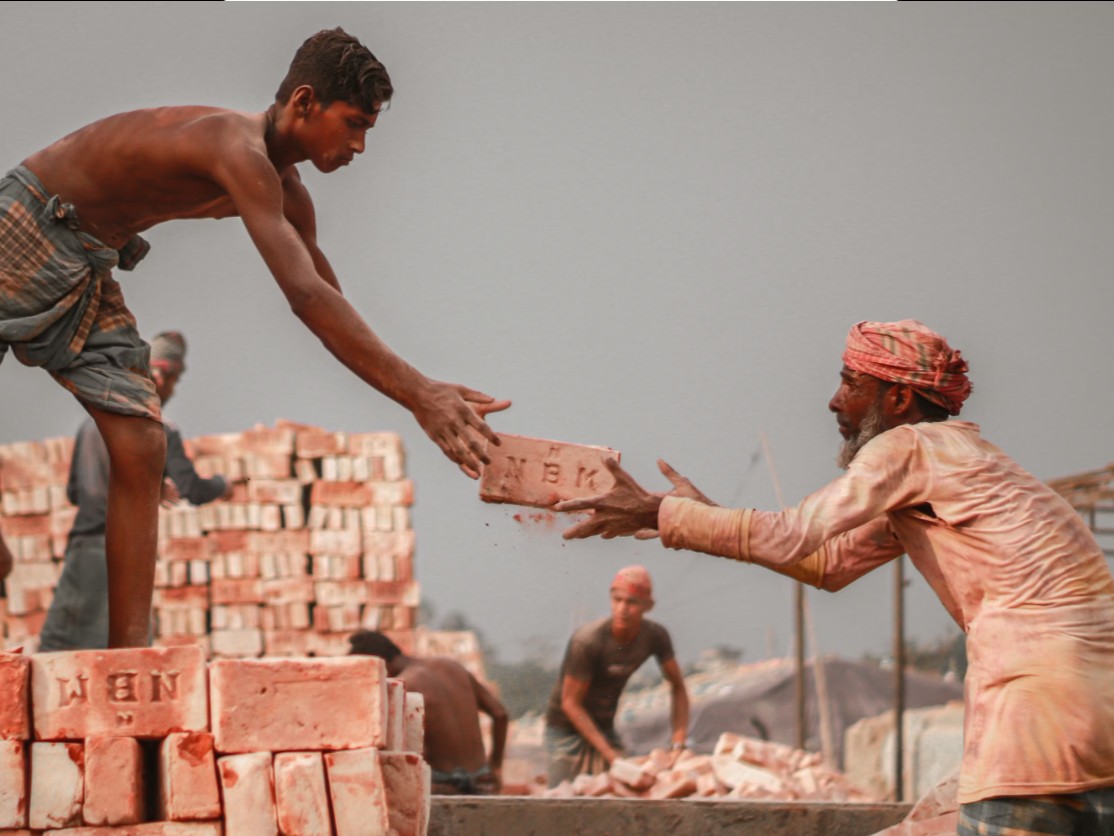
Today is ‘International Labor Day’. On one hand, the world is celebrating this day as a celebration of the contribution of workers and promoting their rights, while on the other hand, the picture is of Indian workers protesting for their rights, who faced criminal cases and prison walls. These workers are protesters demanding their rights in Noida Protest.
After the factory workers protest in Gautam Buddha Nagar, Noida, security has already been tightened on the occasion of ‘Labor Day’ on 1st May. Police forces have been deployed outside big companies. According to the police, to maintain law and order, surveillance is also being done in industrial areas through drone cameras.
There were protests in Noida demanding increase in salary.
Factory workers had protested in Noida since April 9 demanding increase in salary and better working conditions. The demonstration turned violent on 13 April. The police force resorted to lathicharge to control the crowd.
Many protesters were detained after registering an FIR against some workers. According to media reports, the police had put about 350 protesters in jail.
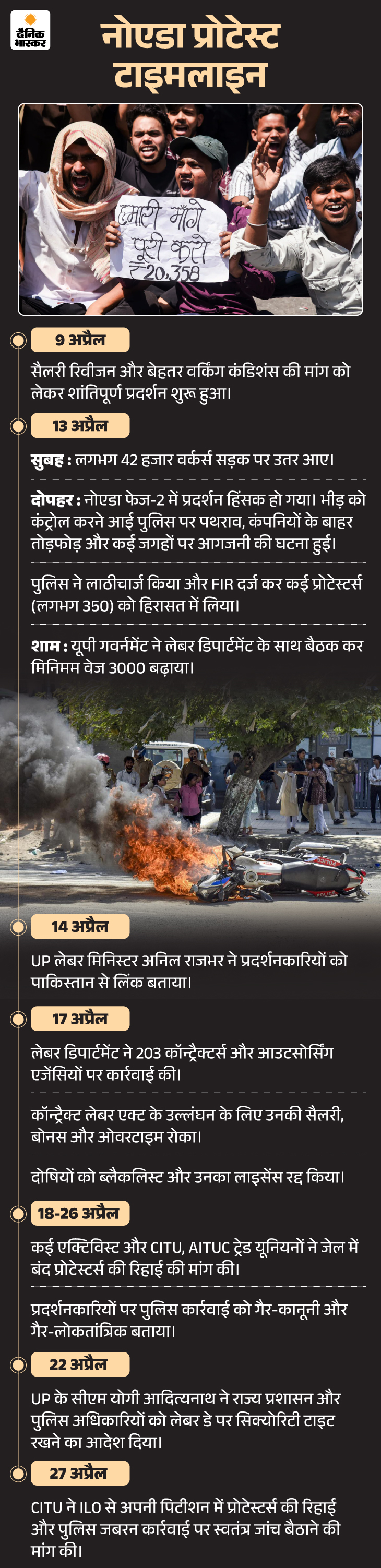
On April 27, Delhi’s Center of Indian Trade Union or CITU has sent a written complaint to the International Labor Organization (ILO) against this action of the government and the police.
More than 1100 laborers including minors detained
Union leaders say that when the strike started, the minimum wage for unskilled laborers in Uttar Pradesh was only Rs 11,314. He says that in an expensive area like Delhi-NCR, workers are expected to survive on such a low income that even basic needs are not met.
The cost of living here has increased manifold in the last ten years, but the minimum wage for workers has not increased accordingly.
The complaint also states that around 350 minors and 800 adults have been detained in Kasna (Ghaziabad).
Demand for independent investigation into excesses of police and government
In a written complaint to the International Labor Organization (ILO), CITU has alleged deprivation of fundamental rights of workers in Noida and violation of trade union rights. Also demanded the release of Noida protesters and an independent inquiry into the excesses of the police and government.
This trade union, affiliated with the Communist Party of India CPI(M), has raised the issue of very serious, large-scale and systematic violations of workers and union rights in its petition sent to the ‘Committee on Freedom of Association’ (CFA) of the ILO.
CITU- ‘Workers have the right to protest peacefully’
CITU says that workers neither have the freedom to join a union, nor the right to organize, nor to collective bargain, nor do they have the right to protest peacefully.
CITU has also accused the Central and Uttar Pradesh governments of violating the fundamental principles of ILO.
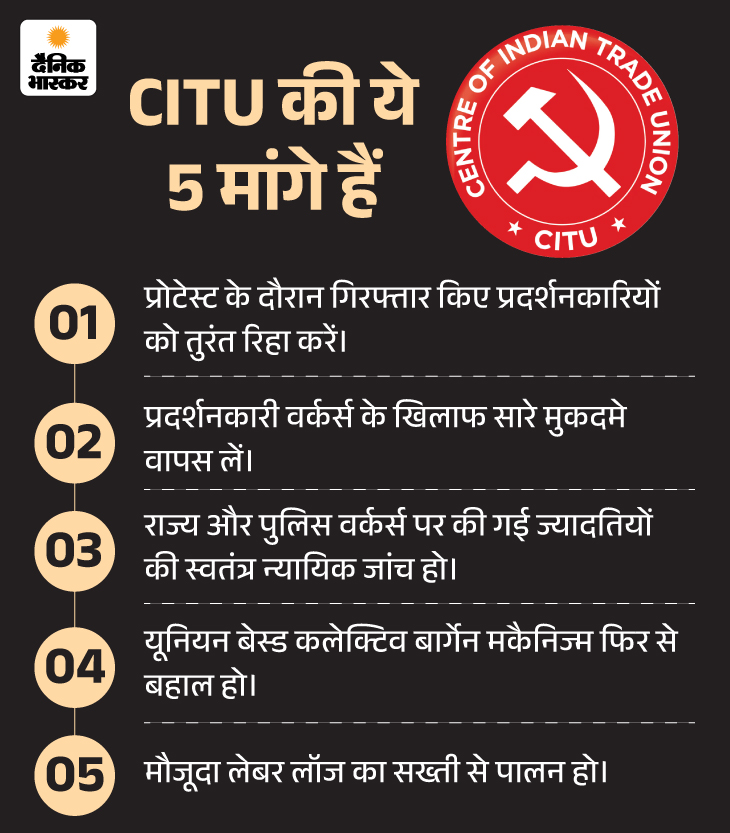
CITU has raised 3 main demands related to Noida-Protest in the petition submitted to ILO:
- The union has demanded the immediate release of the protesters arrested during the protest from jail and withdrawal of criminal cases against them.
- CITU has demanded an independent judicial inquiry to transparently investigate the encroachments (police overreach) on police personnel.
- CITU has raised the demand to restore the collective bargaining system through trade unions.
- The union should have the right to bargain between the company and the worker and decide the salary/working conditions, i.e. the right to decide their own wages, and not just be one-sided.
‘India should adopt the fundamental principles of ILO’
In the petition, CITU has requested the ILO to see that India adopts and abides by ILO Convention No. 98 and the ILO Declaration on Fundamental Principles.
ILO Convention 98 sets out the basic principles of the system of collective bargaining. This means a system where workers, employers and governments can negotiate together on wages, working hours and working conditions.
10 main conventions of ILO i.e. rules related to basic human rights
ILO has created some important conventions to protect the rights of workers. India has accepted some of these, but some have not been adopted yet.
The conventions that India has adopted include:
1. No forced labor (Forced Labor Convention, No. 29)
2. Abolition of Forced Labor (No. 105)
3. Equal Remuneration, No. 100
4. There should be no discrimination in job (Discrimination Convention, No. 111)
5. Fixing the minimum age for children to work (Minimum Age, No. 138)
6. Ending child labor (Worst Forms of Child Labour, No. 182)
Conventions which India has not yet adopted:
7. Freedom of workers to form unions (Freedom of Association, No. 87)
8. Right to Organize & Collective Bargaining, No. 98
9. Right to safety and health at the workplace (Occupational Safety and Health 1981, No. 155)
10. Promotional Framework for Occupational Safety and Health 2006, No. 187
ILO to protect workers’ rights
The International Labor Organization (ILO) is a United Nations (UN) agency that monitors workers’ rights, wages, safety and working conditions.
7 main responsibilities of ILO:
1. Making international labor rules and seeing whether countries are following them or not
- The ILO makes recommendations every year to the International Labor Convention: such as freedom of association, collective bargaining, ban on child labour.
- ILO also checks whether the country has implemented these things in its national law or not, and keeps an eye on them every year by taking reports from the countries.
2. Helping governments to formulate labor policies and programs
- ILO provides technical and financial support to countries: such as increasing employment, skills development, labour-safety.
- This is the reason why many projects and training programs are run in the name of ILO in developing countries, which directly impact the workers or small industries.
3. Hearing and investigating complaints of labor rights violations
- If the rights of labourers/workers are being violated in a country, then trade unions or employers can also send a complaint to the ILO, as CITU has done in the Noida case.
- The ILO puts these complaints before committees like Freedom of Association (CFA), which investigate seriously and then make warnings or suggestions to the government.
4. Does not punish directly, but creates pressure
- ILO cannot forcefully punish any country, but can issue reports keeping its policy in mind, which can create political pressure through international media.
5. Making the fundamental rights of workers equal to human rights.
The core labor standards developed by the ILO include the following:
- Freedom of union or free association
- right to collective bargaining
- Not discriminating on the basis of caste, religion, sex or political opinion,
- Ending conditions of bondage, force or slavery, and
- Strict ban on child labour.
Story- Sonali Rai ————————-
Read this news also…
SC- Private schools cannot stop admission in EWS-quota: Appeal for denying admission to student rejected

The Supreme Court said in its decision on Tuesday that private (non-aided) schools cannot refuse admission to children from weaker and deprived sections under EWS quota. Stopping them from admission is a violation of Right to Education (RTE). This will be a direct violation of Article 21A, the fundamental right of children to education. Read the full news…